Time...and pressure... that's all there is to it, writes Stephen King when talking about geology, in "(Rita Hayworth) and The Shawshank Redemption". From geologies (matter) to biographies (men), a little passage of the time and a little application of the pressure (or emphasis) change not just the texture of the subject but transform the very core itself, to the point that any comparison to the original is just an exercise in futility. Greek history (for that matter, any ancient history), starts off being grounded in reality to some extent, before veering off making the impossible connection with the ethereal. Heroes and heroines are Titans, Gods, or at least descendants of them. Strength and power could only come from their divine gene. Helen could not just be very beautiful, for whom battle ships were launched and battle lines were drawn. That level of beauty could only be because of her direct lineage to Zeus. Same with Achilles. He could have been a great warrior all by himself of his time. But no, he had to be of divine descent too, and his death should be because his mother dipped him, as a baby, head first, holding him by his heel into River Styx, and thus creating his only vulnerability that would later be exploited to kill him. To a modern mind, that's a simple reverse engineering of a story to suit a point of view. Why couldn't Achilles be killed just like any other human being? But he is the greatest warrior the ancient world had ever known... But what has that got anything to do death?
Because, for heroes (and Gods) death, like birth, cannot just be ordinary, like it is with mortals. As that quip from Twain goes, "Let not facts get in the way of a good story".
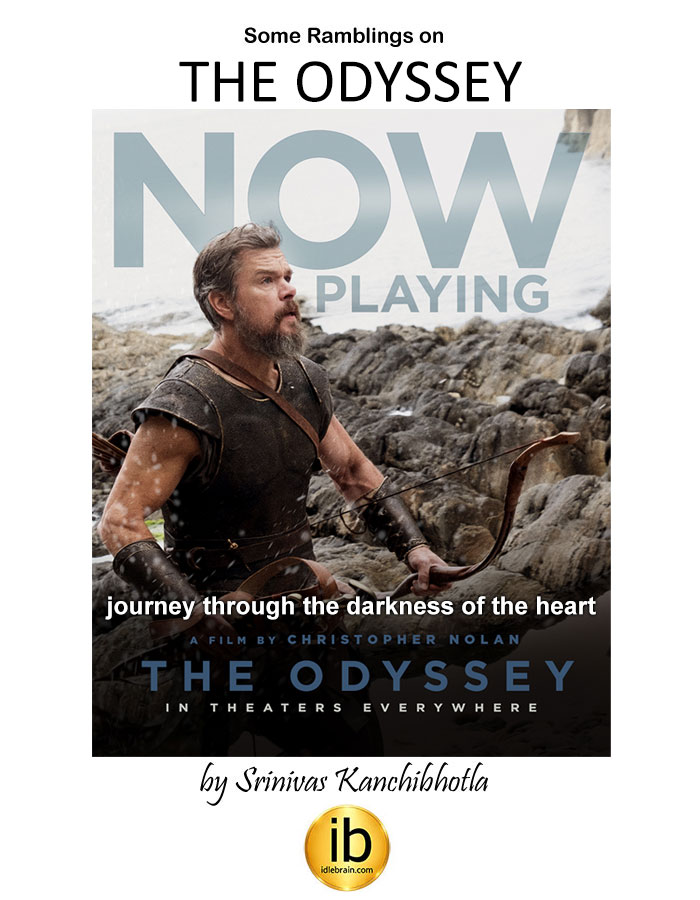
It would have just been an ordinary story of a king, after a great war, while trying to get back home loses his way at sea, in an age when celestial bodies used to be the only navigational guides. And Nolan keeps that way for most of the movie (in spite of the disclaimer at the start that a bit of suspension of disbelief is par for the course here), separating the man from the myth, the fact away from the fantastic, and tries to find the true soul of the second longest poem in the ancient Western literature, "The Odyssey". Much time has passed, about a couple of centuries, since the author of the poem, Homer, strung his words around the voyage of king Odysseus, who took a decade to reach his home for a journey that should have been a couple of months at most. Storms and winds would have been too simplistic an answer to example the Great Drift (though a real world example of a similar incident found a sailor thousands of miles and years away from his destination lost at sea), and so myths soon find a way into the story - Gods were angered by his actions at sea and so throw him off-course through their curses, and he finally gets back home an old man. Just what's the point of the story, apart from being an exciting travelogue, is where Nolan comes in with his insight. Time....and pressure.... create consequences. Nolan's "The Odyssey" is not about the journey, and neither is it about the destination, it is about the consequences.
"The Odyssey" is the most self-referential movie of Nolan's oeuvre, in that, it has traces of "Memento" with memory loss, a bit of "Inception" with being lost in limbo, "Interstellar" rears its head with the father trying to make it back to his family, "Dunkirk" does a fly-by with soldiers trying to survive coffin like conditions locked up in a vessel, and the recent "Oppenheimer" sounds its loudest resonance, with the hero struggling with the consequences of unleashing upon the world a stealth weapon that's put to use for disastrous results. And in that parallel to Oppenheimer, Odysseus' journey doesn't just become a maritime blunder, but it morphs into a penance of sorts, as though a self-imposed banishment from his family was the only fitting punishment to unleashing barbaric wrath on an unwitting civilization (Calypso even asks him at a point, "why don't you want to go home? what are you escaping from?"). For the treachery that the Trojan horse he designed becomes a symbol of, the man, quite ironically, recedes into a shell, thereafter, burdened by guilt, weighed down by the choices at war and at sea, unable to keep a lid on his conscience any longer (in a brilliant choice, having internal conversations with Athena, the God of Wisdom). And so he suffers, his fate. The curse was of his own making, and the consequences, all too real.
"The Odyssey" is probably Nolan's most accessible movie to date, a strong character piece in a self-cathartic tone. For all the plot-heavy and character-thin fare that he is often accused to dabble in, Nolan turns the lens inward this time and tries to find the humanity in the hero, than his usual, hero trying to traverse the maze of the system. In an interesting parallel to Kubrick's career, whom Nolan's is often compared to, for the cold and clinical take on the proceedings, Kubrick progression starting off being close to the characters but in time moving much farther away from them, finds an inversion in Nolan, who started off with the same distant, objective view but from the last couple of features, started moving closer and personal. Perhaps, humans with all their failings and fallibilities and fault lines are much better subjects than simple "complex systems".
Tailpiece: The Coen brothers did their own (direct) take on "The Odyssey" with their wacky "O Brother! Where Art Thou?", a musical (of course, what else could Homer's poem be? A prose?) about three Depression era dim-wit fugitives traversing the dust bowl seeking secret fortunes and finding adventures instead, all set against a killer soundtrack of Bluegrass gems. Even in there, the journey is not of any particular value, but a reformed husband going after a heartbroken wife brings the much needed humanity to all the running around. Turns out, Homer's epic has better resonance in the modern times than in the heartless era it was set in.
checkout http://kanchib.blogspot.com for Srinivas's Blog.