Story
There is a small tribal hamlet nestled in the hills near Vizianagaram. The village doesn't even have an official name; people simply refer to it as 'Konda Krindi Ooru' (the village beneath the hill). The residents lack basic identity documents, and the village itself remains unrecognized by the government.
Peddi belongs to this village and, like many of its residents, travels to Vizianagaram every day in search of daily-wage work. He is also a gifted sportsman who earns money by playing for local teams as an 'Aata Coolie' (a player hired for matches). With his explosive batting and entertaining performances, Peddi soon becomes a popular figure in local cricket circles.
Another villager, Appalasoori, dreams of getting a train to stop near their village, as the trains that pass through never halt there. Meanwhile, an unfortunate incident becomes a turning point in Peddi's life. Although he is widely known across Vizianagaram for his cricketing talent, he realizes that neither he nor his fellow villagers officially exist in the eyes of the system. He has no identity card, and his village doesn't even have a recognized name.
Shaken by this reality, Peddi sets out on a mission. The rest of the story follows his inspiring journey as he rises to the highest levels of sport, determined to bring recognition to his village and its people. His ultimate goal is to ensure that the government acknowledges their existence, gives the village an official name, and provides identity cards and basic rights to its residents.
Artists Performance
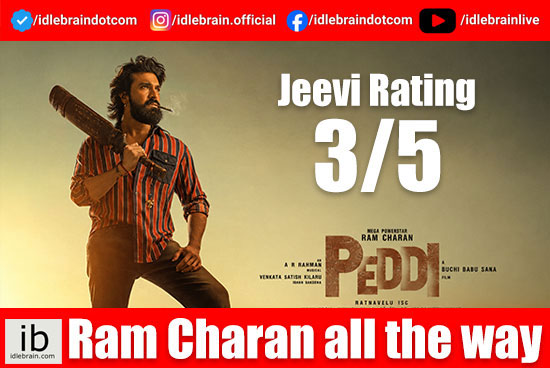
Ram Charan: Ram Charan looks absolutely phenomenal in this film. As a performer, he seems to have reached a new peak with Peddi. He plays a free-spirited adventurer who lives by the philosophy of "Pudathama Yeti Malli?" - a rustic take on You Only Live Once (YOLO). There is an effortless rural swagger in his body language that makes the character instantly memorable.
As the film progresses, the distinction between the actor and the character gradually disappears, making it feel as though Ram Charan and Peddi have become one and the same. His performances in the pre-interval episodes, the Delhi portions, and especially the climactic speech firmly establish him as one of the finest actors of his generation.
Choosing a content-driven film of this nature is a courageous move for a star of Ram Charan’s stature. The dedication he invested in physically transforming himself into a wrestler is evident throughout the action and sports sequences.
Ram Charan is exceptionally natural in the dance sequences, and all the songs released so far have already become chartbusters. However, what impressed me the most were the action sequences in the first half, particularly those before he enters the wrestling arena. The fights are choreographed with such style and flair that they almost resemble dance performances, enhanced by Ram Charan’s signature “cuts” that fans associate with his dancing.
This is a performance that deserves to be remembered for a long time. If there is justice, one can certainly expect Ram Charan to be a strong contender for a National Award for his work in Peddi.
Other actors: Janhvi Kapoor adds glamour to the film, though her characterization feels disconnected from the movie’s central theme. Jagapathi Babu delivers a standout performance as Appalasoori, a pivotal character in the narrative. His makeup, body language, and dialogue delivery bring remarkable authenticity and depth to the role.
Shiva Rajkumar is excellent as the former wrestling champion turned coach. Backed by a well-written character, he leaves a strong impact. Divyendu Sharma performs effectively as the antagonist in the first half. Shruti Haasan makes a special appearance in a song and adds to its appeal.
Satya plays the hero’s friend, neither significant nor comical. The actor who narrates Peddi’s story to Boman Irani is impressive. Upendra Limaye gets a well-written role and delivers a performance that does complete justice to the character. Tarak Ponnappa gets an interesting role and performs commendably.
Boman Irani, Rao Ramesh, Harish Peradi, Ravi Kishan, Ajay Ghosh, Srikanth Ayyangar, Mahesh Achanta, and Chammak Chandra play other important supporting characters and contribute effectively to the film.
Story - screenplay - direction:
The basic storyline is highly inspiring and carries strong box-office potential. At its core, Peddi is the story of a man who initially lives for himself, earning money by playing sports, but gradually transforms into a disciplined and professional athlete driven by a larger purpose - to secure an identity for his village and its people.
Director Buchi Babu Sana writes this powerful premise and executes it effectively for the most part. His characterizations, particularly those of Ram Charan, Jagapathi Babu, and Shiva Rajkumar, are exceptionally well written and form the backbone of the film. The screenplay is competent, though the narration occasionally lacks fluidity. While the conflict is established convincingly in the first half, the storytelling doesn't always flow as smoothly as it should.
The heroine’s track feels disconnected from the film’s central narrative, making it seem out of place. However, the emotional core of the film gathers momentum during the pre-interval sequence and remains engaging throughout the second half. The climax and the post-climax portions are especially moving and leave a lasting emotional impact.
Buchi Babu Sana appears to be developing a distinctive storytelling style when it comes to presenting his heroes. While his vision is evident throughout the film, the dubbing for certain characters fails to create the intended impact. Boman Irani’s character, in particular, suffers from this issue.
The sports episodes are among the film’s biggest strengths. The cricket sequences are entertaining and crowd-pleasing, while the wrestling portions are packed with emotion and intensity. Overall, Buchi Babu Sana delivers a commendable directorial effort, ensuring that the emotional beats land effectively whenever the story demands them.
Other departments: Among the technical departments, the highest praise goes equally to AR Rahman and Rathnavelu. AR Rahman is exceptional with both the songs and the background score. The Peddi soundtrack has already become a chartbuster, and once again, Rahman rises to the occasion when presented with a story that inspires him. What stood out most for me was the English-themed background score used during Ram Charan’s elevation sequences, which adds tremendous impact to those moments.
Rathnavelu’s cinematography is equally outstanding. Capturing a film that constantly shifts between multiple sports and emotional moods is no easy task, yet he handles it with remarkable finesse. The variations in lighting, framing, and lensing distinctly reflect the changing worlds within the film. The Delhi episodes, in particular, were shot on actual film stock rather than digital cameras, lending those portions a striking sense of realism and texture. The difference is evident on screen, and even the aspect ratio changes subtly during these sequences, enhancing the cinematic experience.
The decision to rely on elaborate sets and real locations rather than excessive CGI adds a strong layer of authenticity to the visuals. Production designer Avinash Kolla deserves special mention for his exceptional work in creating the film’s world. Much of Peddi was shot on sets, yet they feel completely natural and lived-in. This is one of those rare big-budget Telugu films where a significant portion of the budget has gone into tangible production design rather than visual effects.
The dialogues penned by Buchi Babu Sana are one of the film’s biggest strengths. They are powerful, thought-provoking, and emotionally resonant.
Naveen Nooli’s editing is effective overall, although a few portions in the first half feel slightly uneven in terms of flow. The action choreography is impressive throughout. The cricket sequences generate an adrenaline rush, while the wrestling portions are staged with a level of professionalism and intensity that enhances the film’s emotional stakes.
Dance choreographer Jani Master deserves a special mention for his contribution to the film. While his work is evident in the songs that were released before the film's release and went on to become hugely popular, he also adds immense value through the bit songs that appear during crucial portions of the narrative.
Producer Venkata Satish Kilaru has backed the film with grand production values, ensuring that the scale and ambition of the story are reflected in every frame.
Analysis: Peddi is a content-driven film that successfully blends a strong emotional core with enough commercial appeal to engage a wide audience. Ram Charan, Buchi Babu Sana, and producer Satish Kilaru deserve special appreciation for preserving the soul of the story, particularly in the last 30 minutes, without resorting to unnecessary commercial compromises. The film stays true to its emotions and convictions when it matters the most.
A compelling story always finds its audience, and Peddi is a testament to that. Ram Charan’s outstanding performance, combined with exceptional technical contributions—especially AR Rahman’s music and Rathnavelu’s cinematography—elevates the film significantly. While there are a few uneven stretches and occasional dull moments, they do little to diminish the overall impact.
After a long time, here is a big-budget, highly anticipated Telugu film that places content and honest storytelling above formula. It is definitely worth watching.
|