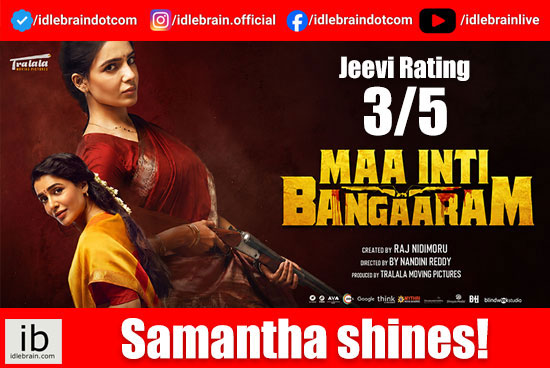
Story
Swarna (Samantha), an orphan, marries Dr. Anirudh (Diganth Manchale) against the wishes of his father. Three years later, the couple returns to Anirudh’s hometown to attend a family wedding. As Swarna steps into her husband’s ancestral home, she finds herself struggling to gain the acceptance and affection of her in-laws.
Just as she begins to navigate these challenges, a shadow from her past resurfaces. A man aware of her hidden history informs Karuna (Gulshan Devaiah), a convict currently serving a prison sentence. His involvement threatens to expose secrets that Swarna has carefully concealed from her husband.
The rest of the story unfolds as Swarna’s buried past comes back to haunt her, forcing her to confront truths and deal with the consequences of the life she left behind.
Artists Performance
Samantha: Samantha delivers an outstanding performance in the titular role, a daughter-in-law determined to find her place within a family that is reluctant to accept her. She looks graceful and elegant in sarees throughout the film, and it is refreshing to see her carry the traditional attire even during the action sequences.
What stands out is how convincingly she transitions between vulnerability and strength. Whether it is the emotionally charged moments or the high-intensity action scenes, Samantha remains completely true to the character. She handles every emotion with finesse and brings authenticity to Swarna/Jhansi’s journey, making the character both relatable and compelling.
Others: The casting of the female characters is one of the film’s major strengths. Manjusha Mukkavilli, who transitioned from being an Instagram influencer to an actress, gets a substantial role and delivers a remarkably natural performance. Holding her own in scenes alongside Samantha is no easy task, yet the chemistry between the two consistently brings warmth and smiles to the audience.
Sreemukhi is equally impressive as the competitive daughter-in-law who strives to outdo everyone in every household responsibility. Rachana, best known for Seethamma Vakitlo Sirimalle Chettu, gets a good role and delivers a beautiful performance.
However, the film follows the familiar trend of casting male actors from other industries opposite a leading Telugu heroine. The casting of Diganth Manchale as the heroine’s husband doesn’t quite click. While Gulshan Devaiah delivers a commendable performance and does justice to his character, the presence of both Diganth and Gulshan in pivotal roles gives the film a dubbed-film feel at times, rather than that of a straight Telugu production.
Among the supporting cast, Srinivas Gavireddy performs well, while Srilakshmi and Gautami are excellent in their respective roles. Anand is effective as the family patriarch, and Chaitanya also leaves a good impression. Vennela Kishore makes a brief appearance towards the end and provides some hilarious moments, ending the film on a lighter note.
Story - screenplay - direction:
At its core, the film follows a Baasha-style template, but places it within the fresh and unconventional setting of a daughter-in-law trying to find acceptance in a traditional joint family. The biggest distinction is that the protagonist is a woman rather than a man.
In most films inspired by the Baasha formula, the hero is revealed to have a larger-than-life past—either as a savior of the masses, a feared gangster, or a powerful force commanding respect. With a female protagonist, the possibilities are naturally different. Typically, such characters are portrayed either as patriotic figures serving the nation, secret agents handling dangerous missions, or individuals drawn into extremist movements. Since this story is set in the 1990s, the flashback avoids the usual heroic elevations and instead takes a more restrained approach, focusing on a compelling mentor-turned-adversary relationship.
The screenplay works effectively because Swarna’s past must remain hidden from her family. Any revelation threatens to further damage her already fragile relationship with her in-laws, creating a constant sense of tension. The antagonist, however, is not the kind who relies on brute force. He operates psychologically, manipulating situations and people. As a result, the second half does not offer the conventional highs, confrontations, and payoffs that audiences generally associate with this genre.
That said, the final twenty minutes are handled impressively. The climactic face-off between Samantha and the antagonist unfolds through a carefully structured setup, reminiscent of the strategic climaxes seen in films like Khaidi. However, the female-centric perspective gives it a fresh flavour and makes it engaging in its own right.
If viewed without expecting a traditional Baasha-style flashback payoff, the second half works reasonably well. But audiences comparing it with classics such as Baasha or Athadu may find themselves wanting more from the latter portions. Thankfully, Vennela Kishore’s hilarious cameo during the rolling credits provides a welcome breather after an emotionally intense climax.
The writing team of Raj Nidimoru, Vasanth Maringanti, and Sita Menon deserves credit for crafting an engaging narrative. Director Nandini Reddy skillfully balances family emotions, suspense, and action, delivering a film that feels distinctive while retaining enough commercial appeal to connect with a wider audience.
Other departments: The music is one of the film’s biggest assets. The song Thassadiyya is excellent and blends seamlessly into the narrative, enhancing the mood of the film. The classic “Muthyamantha Pasupu” song has been incorporated beautifully in its original form, adding both nostalgia and emotional value. I also loved the way Bapu’s artwork has been showcased during the title credits. The background score is highly effective, elevating both the family drama and the action-packed moments.
Om Prakash’s cinematography is another major strength. He ensures that every frame in the family portions looks visually pleasing while creating the necessary tension and urgency during the action sequences. The use of handheld camerawork in the fight scenes adds a sense of realism and intensity. This is particularly evident in the climactic confrontation between Samantha and Gulshan Devaiah, where the camera becomes an active participant in the drama.
The dialogues are thoughtfully written and leave a strong impact. Lines such as “Intiki andaru Mahalakshmilu kaanakkarledu... Kaalika kooda devathe” stand out, along with several other memorable exchanges. The meta reference to Srilakshmi’s iconic poetry track from Chantabbai is another delightful touch.
Dharmendra Kakarala’s editing is sharp and effective. The action sequences are designed in a way that they deliver maximum impact while remaining believable. The bus fight sequence, in particular, features an impressive long take that stands out for its execution.
The production values from Tralala Moving Pictures are excellent, ensuring that the film looks polished and rich throughout.
Analysis: Maa Inti Bangaram is an engaging and entertaining family drama that skillfully blends action elements into its narrative. Samantha shoulders the film with remarkable ease, combining her star power and acting prowess to deliver a compelling performance. While the writers work with a familiar premise, they bring enough fresh ideas and unique touches to keep the storytelling interesting. The film is likely to resonate strongly with family audiences, who are its primary target demographic. Though there are a couple of minor shortcomings along the way, the film’s strengths far outweigh its weaknesses. With its mix of emotions, action, and family dynamics, Maa Inti Bangaram emerges as a satisfying theatrical experience and is well worth watching on the big screen.
|