Story
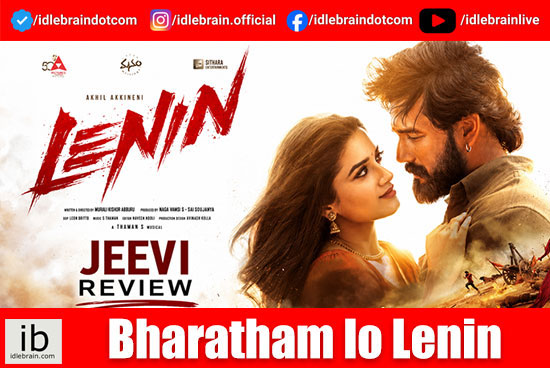
Lenin (Akkineni Akhil), an orphan, is adopted by Jayanthi (Easwari Rao) alongside her biological son Vasanth (Pramod Panju) in the 1990s. He grows up and falls in love with Bharathi (Bhagyashri Borse). Set against the backdrop of the Draupathi Jathara, the film unfolds amidst the rivalry between two neighbouring villages. The story follows how the personal agendas and hidden motives of various characters intertwine, ultimately shaping Lenin's life and destiny.
Artists Performance
Akhil Akkineni: Akhil Akkineni has undergone a convincing physical transformation for the role, sporting a slightly bulked-up physique, a light beard, and a tanned look that perfectly complements his rustic character. He has also mastered the Chittoor dialect and delivers a sincere, grounded performance. Akhil completely immerses himself in the role, making the audience see only the character and not the star.
Bhagyashri Borse leaves a strong impression as the female lead, bringing warmth and emotional depth to her scenes. Kannada actor Pramod Panju excels in a pivotal role with a measured performance. Sivaji is outstanding as a layered character, portraying intensity with remarkable conviction. Brahmaji is thoroughly entertaining in a role reminiscent of Sakuni, with his body language and expressions adding to the film's charm. Sunil appears as a police officer, though his character is comparatively straightforward and lacks the complexity seen in the rest of the cast. Easwari is effective as the mother, while Ramki makes a pleasing presence in a positive role. Getup Srinu has limited screen time. Interestingly, the makers have ensured that even the smaller roles are played by familiar and capable actors, adding strength to the film's overall ensemble.
Story - screenplay - direction:
Writer-director Murali Kishor Abburu, who made an impressive debut with VBVK, returns with another story built around suspense and layered twists. He crafts the characters and backdrop by drawing references from the Mahabharata. Nearly every character appears ordinary and well-intentioned at first, but as the narrative unfolds, their grey shades gradually come to the fore.
Murali chooses to narrate the film in a serious tone, offering very little comic relief apart from Brahmaji's character. The screenplay follows a non-linear, back-and-forth narrative, with an engaging interval twist that raises curiosity. The second half unfolds alongside the climax, with each character revealing their true motives one after another.
While the screenplay is well structured, the characters could have been made more relatable to establish a stronger emotional connection with the audience. The biggest reveal involving the hero's true capability arrives rather abruptly and quite late, reducing its impact. It might have worked better had this twist been revealed to the audience around the interval, allowing viewers to enjoy watching the hero outsmart the other characters who remain unaware of it.
Since the story is set in the 1990s, the absence of mobile phones naturally creates communication gaps that work in the screenplay's favour. At the same time, the makers also acknowledge the period's evolving technology by showing a character using a pager for communication in one scene, adding authenticity to the setting.
The director opts for a heavy, action-driven narrative rather than allowing the revenge emotion to build steadily toward the climax. Even so, Murali Kishor Abburu delivers a reasonably engaging film that showcases his flair for writing intricate characters and suspenseful storytelling.
Other departments: Leon Britto's cinematography is one of the film's highlights. His visuals flow effortlessly and beautifully capture the rustic atmosphere, adding richness and authenticity to the narrative. S. Thaman's music works well in parts, with Jaya Mangalam emerging as a standout song. His background score is effective in several key moments, though it could have been more consistent throughout.
The dialogues penned by Murali Kishor Abburu are good and suit the tone of the film. Avinash Kolla's production design deserves special appreciation for its meticulous detailing and authenticity, creating a believable world for the story. Naveen Nooli's editing is neat. The production values from Manam Enterprises and Sithara Entertainments are lavish, ensuring the film looks visually rich.
Analysis: Lenin is a love-action drama that draws parallels with the Mahabharata. It boasts a well-crafted screenplay, strong characterisations, and impressive performances. Technically, too, the film is rich. However, greater depth in the romance between the lead pair would have provided a stronger emotional foundation. The emotional moments could have been more impactful. Despite a few hiccups, Lenin emerges as a reasonable film with something to offer for every section of the audience.
|